MA in TESOL Graduate Interview – Josh McMillen
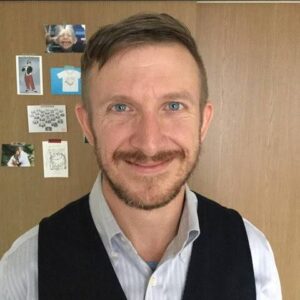
Why did you choose Anaheim University’s MA in TESOL program? I chose this program because of the quality of the professors and the online setup allowed me to keep a flexible schedule. Also, Anaheim does not have a practicum, which is great. Anaheim recognizes that its students are already working in TESOL situations, so we can use the settings that we are currently in to aid us in our studies. Can you tell us about your career to date? Currently, I am working in Japan as an Assistant Language Teacher (ALT) with the JET Program. I work at one junior high school and two elementary schools. How do you expect your Masters to further your career? Having a Masters qualifies you for better teaching positions and helps your employer to have more confidence in your abilities. I now know a great deal more about my field than I did when I started in the program. Can you share a favorite memory from Anaheim University? The residential sessions really stick out. It was great to meet people and the professors face to face. Did you have a favorite class at Anaheim University? Honestly, it is hard to pick just one. With many of the classes, I looked forward to the next lesson because the professors were so interesting. Even though the classes were all online, the professors created an engaging community environment that I enjoyed logging in to every week. How did you enjoy the online experience? This was my first fully online classroom experience and I truly enjoyed it. It was so convenient. Who would you recommend Anaheim University’s MA in TESOL program? Anyone interested in TESOL. What were the challenges in your program? Starting the program was a challenge for me. I was worried about how I would do because it had been years since my last classroom experience, I had never had a fully online class, and I just became a father. The professors and office staff were very helpful, which put me at ease. The user interface was easy to navigate and the internet connections were great. Because of the time difference between Anaheim and Japan, I always had classes on Saturday mornings, which was great because my son was either still asleep or just waking up. The class timing worked out great. Because everyone was so helpful and supportive, any challenge that came up was very manageable. In your opinion, how does learning TESOL improve careers for ESL teachers? Learning TESOL gives ESL teachers more tools to use in their “teaching toolbox.” Learning new methods helps you to become more analytic when tracking your students’ progress. Could you please tell us about your Research Portfolio? I enjoyed my portfolio experience mainly because of the weekly readings and journaling format. The readings helped me to understand complex topics and the journals allowed me to wrestle with these ideas and come to my own understanding. Which residential sessions did you attend and what did you like best about them? I attended both sessions in Tokyo (in August 2016 and August 2018). Meeting people and making connections was a great part. How did you feel connected to your learning community? I thought that it would be hard to feel connected because the classes were online, but I felt a real connection with my community. Professors were quick about emailing back. The weekly forums helped us all to stay connected throughout the week. What advice can you give to new students entering the MA in TESOL program? If you have any questions about anything, do not hesitate to ask. The professors and staff are more than willing to help. Do not be intimidated by the professors. I was surprised at how down to earth and easy to talk to they were. If you are having problems with anything, let people know. They want you to succeed. Other comments I am happy to graduate, but a little sad that it is over.
Ed.D. in TESOL Graduate Interview – Bradford Lee
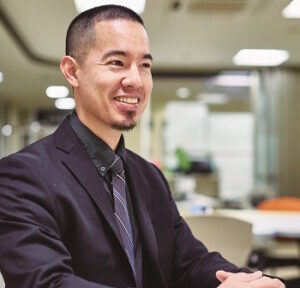
Bradford Lee 1. Why did you choose Anaheim University’s Ed.D. in TESOL program? – I chose Anaheim University’s Ed.D. TESOL program to have the opportunity to work with some of the biggest and most influential researchers and practitioners in the field. 2. Can you tell us about your career to date? – I have been living and working in Japan since 1999 and have taught students of all ages and levels from 6 months to 90 years old. I have worked in Eikaiwa, public elementary and junior high schools, and 2-year colleges. I’m currently a Lecturer with tenure at a private university. 3. How do you expect your Ed.D. to further your career? – I believe the obtainment of a Ed.D. allows me to be competitive for promotion to higher levels (Associate or Full Professor) at my institution, and adds gravitas and a sense of trust when I apply for grants and federal funding which are important for my career development. 4. Can you share a favorite memory from Anaheim University? – My favorite memory from Anaheim University was during the Residential Sessions, where we had the chance to meet with our professors and classmates face-to-face. 5. Did you have a favorite class at Anaheim University? – My favorite class was probably Instructed Second Language Acquisition (EDU 700) with Dr. Rod Ellis. This class was a thorough review of theories and methodologies that form the basis of our entire field and being able to discuss them with Dr. Ellis was an amazing opportunity. 6. How did you enjoy the online experience? – I thought the online experience was great, and very convenient. Luckily the time zone difference between CA and Japan was such so that classes were always held Saturday morning for me, so attendance was mostly possible. On the times when I’d be traveling or working, I was able to use the app on my mobile with Bluetooth earbuds! 7. Who would you recommend Anaheim University Ed.D. program? – I think that anyone could benefit greatly from Anaheim’s Ed.D. program. 8. What were the challenges in your program? – For me, the biggest challenge was keeping up with the weekly discussion forum (DF) assignments, which required heavy reading and thought in order to answer in a meaningful manner. However, as difficult and inconvenient as they were, there’s no doubt that they FORCED me to do my reading in a timely manner, which translated into an increased experience at the end of the week at the real-time sessions with the professor. 9. In your opinion, how does learning TESOL improve careers for ESL teachers? – I think that learning theory and current practices helps ESL teachers in the classroom because it addresses many issues that ESL may be having and gives suggestions to the root cause and possible solutions. In the case where the solutions don’t work quite exactly right, it becomes possible for the teacher to engage in action research and become part of the discussion, rather than feeling frustrated or despair on their own. 10. Please tell us about your experience in the Oral Defense. Were you nervous beforehand? – Of course I was nervous! I was not really sure what to expect, and therefore I think I over-prepared with my PowerPoint slides, etc. Many of the questions I was asked were hard-hitting, make-or-break style questions and even though I had been working on my project for almost a full year, there were many aspects that I realized I had overlooked. Fortunately, I was able to justify most of my decisions in the project. Those aspects that were lacking, I was able to address in revisions. 11. What was your dissertation topic and why did you select it? – My dissertation was on Pronunciation Instruction, namely, what is the best way to teach it. This had always been an interesting topic for me, as it was my experience that many of my students would speak grammatically correct sentences but would still not be understood by native speakers due to their accents. The students would think that they were using the wrong vocabulary or grammar and try to rephrase or go into a panic, when really the issue was a simple one of intonation, etc. Seeing this scene played out hundreds of times, especially when I would bring groups of students to the U.S. for study abroad, made me interested in developing the most effective system of instruction. 12. Which residential sessions did you attend and what did you like best about them? – I went to both Residentials held in Tokyo (2016, 2018). The best part of the sessions were not only the lectures themselves, but also being able to go out for a meal and a drink with our classmates and professors. 13. How did you feel connected to your learning community? – Attending the Residentials, which have open seminars on the 3rd day, helped me feel a sense of connection with my A.U. classmates and also the field of TESOL on the whole. 14. What are your future plans now that you have completed the Ed.D.? – Now that I’ve completed the Ed.D. I have been finishing up some projects that I had left open while I pushed for the finish line, while also starting new projects that I can focus on now that my workload had considerably lightened. I’m currently working on projects involving: • TESOL teacher motivation • pronunciation • task-based instruction • curriculum design • dyslexia 15. What advice can you give to new students entering the Ed.D. program? – My advice for new students entering the Ed.D. program: just do it! I think the thing that kills a lot of projects, dreams, and sometimes careers, is wasting time. Wasting time debating whether to do a thing or not or procrastinating. I tried to just grab a can of Monster, sit down at my computer, and START. That’s the only one you’re ever going to FINISH! (^-^)
Interview with Dr. Masatoshi Sato
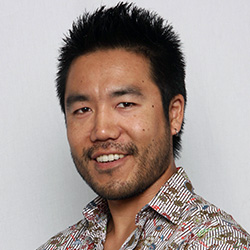
Dr. Masatoshi Sato Anaheim University welcomes new faculty member, Dr. Masatoshi Sato. Dr. Sato earned his Ph.D. in Educational Studies: Language Acquisition and a Master of Arts in Second Language Education from McGill University, as well as a Graduate Certificate in TESOL from the University of New Mexico and a Bachelor of Arts in International and Intercultural Communication from Kobe University. Dr. Sato is currently an Associate Professor in TESOL at Anaheim University. He has also published various international journals and recently co-edited books from John Benjamins. We recently interviewed Dr. Sato to discuss online education and his thoughts on the field of TESOL. Q. What are your specialties? – I’m generally interested in how SLA research could help teachers teach second language, no matter what the second language is. I have done research on peer interactions and professional development in teacher education. My primary area of research is peer instruction and how this facilitate second language learning. This research is relevant to the overall category, which is called instructed second language acquisition. Q. What do you enjoy most about teaching at Anaheim University so far? – I enjoyed the diversity of students, who come from different backgrounds, have different teachings, and professional experiences. The interaction I had with this diverse group of students was incredibly interesting. Q. What do you think are the strengths of the online Ed.D. in TESOL program at Anaheim University? – Anaheim University recruits students from anywhere in the world and this puts the online program ahead. This is because of the diverse selection of students, in terms of their backgrounds, which does not happen in traditional TESOL programs, where students are often from similar backgrounds. Q. What are the benefits of online education? – The flexibility that online education offers is astounding. The online education program at Anaheim University is able to be divided into two parts, synchronous and asynchronous. For the asynchronous part, students have flexibility in terms of completing assignments, participating in their respective classes and being up-to-date on viewing recorded lectures. With the synchronous aspect, students are able to have access to their resources for the course anywhere. Q. What are the benefits of learning TESOL for English teachers? – One issue a lot of English teachers tend to have is not having theoretical underpinnings or research backup for their pedagogical decisions when they choose certain teaching methods. In order for teachers to make more important pedagogical decisions, it is necessary to know or learn SLA theories and research findings to transfer to second language education. Q. In your opinion, what does the future of online education look like? – Online education has been around for a long time, but it is getting more popular. I do think as online education becomes more common, there will be some backlash that comes with it. Q. Who would you recommend the Ed.D. program at Anaheim University to? – I would recommend the program for students who have some knowledge of second language learning and teaching. It appears to me that students do not have a deep understanding of theoretical or research issues to become a doctorate student, but in general, I would definitely recommend the program for those who have teaching experience with a certain amount of knowledge related to second language learning and teaching. Q. What advice would you give to someone who is aiming to be a scholar in the field? – If someone were to become a scholar, that individual should have the mentality to contribute to society. They should learn how to solve real-world issues instead of answering theoretical questions only. Another important note to keep in mind is that, in the current research world, publication is everything. So, in order for someone to become a successful scholar, they should be able to conduct solid research and write well. Q. What do you think are the challenges that English teachers in Japan are facing? – It really depends on what “English teachers” means in this question. The struggle is that a lot of English teachers in Japan teach English in their native language. Nowadays, the Government is asking English to be taught in English, not in their native language, which perceives to be an issue for some teachers to make fundamental changes. But I do think this is a good change. I believe that English should be taught in English. I also want to bring attention to the issue of English teachers invited to Japan to teach English but are not qualified. Their academic content knowledge of second language teaching is not asked for. Therefore, a challenge for the future is the training of those teachers so they become more capable teachers in Japan. Q. What advice would you give to new language teachers? – Try to finish the necessary research in a limited amount of time, be creative, keep in mind why you decided to use certain teaching methods or activities, and make adjustments all the time. Always know the student’s individual differences and create a non-threatening collaborative classroom environment. Promote the student’s language production, let the students be aware that making errors in second language is a good thing. Lastly, always let students express their opinions, which are definitely interesting.
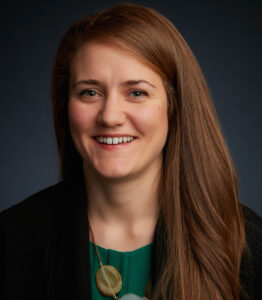
Anaheim University Graduate Interview – Ryane Willis
1. Why did you choose Anaheim University’s MA in TESOL program? I chose the Anaheim program because it gave me access to pioneering researchers in the field of TESOL. There was a level of quality in the instruction that I could not find in my home state. 2. Can you tell us about your career to date? I have taught in an Intensive English Program (IEP) for the past 5 years. 3 years into my career, I realized that I would not be promoted without a MA degree in the field. I decided to go back to school for my second master’s degree. Now I work full-time at the University of Oklahoma as an instructor at the Center for English as a Second Language. 3. How do you expect your master’s to further your career? My master’s degree has already furthered my career. I’ve developed into a different teacher as a result of the degree. I approach my classes with a critical mindset, look for trends and data, and reflect on the research so I can implement it in my courses. 4. Can you share a favorite memory from Anaheim University? The residential sessions are always the highlight of the program. 5. Did you have a favorite class at Anaheim University? I had mainly excellent classes. EDU 570 taught me how to analyze my own tests, EDU 530 Discourse Analysis helped me understand the challenges my students face in understanding authentic discourse, and EDU 520 helped me actually teach pronunciation in a meaningful way. Each of these courses changed the way I teach. 6. How did you enjoy the online experience? I enjoyed the online experience because I got to collaborate with teachers in different settings. Their teaching situations brought insight into my own setting. 7. Who would you recommend Anaheim University’s MA in TESOL program? I’d recommend someone with a bit of teaching experience under their belt. I think it would be hard to enter this program without ever stepping foot in a classroom, but getting to study your own students and your own teaching deepens your learning on the subject. 8. What were the challenges in your program? It takes a lot of energy to teach all day and work on a master’s at night. Even though you are tired, there is so much value in learning as you are teaching. You learn new ideas in your Anaheim classes and then try them in your English classes. Essentially, you learn everything twice. It is a very worthwhile process. 9. In your opinion, how does learning TESOL improve careers for ESL teachers? I think a TESOL degree accelerates the process of becoming a professional educator. It gives you the confidence and perspective beyond your own experience. Experience is an excellent teacher, but it is important to be exposed to new ideas. 10. How did you feel connected to your learning community? You end up taking classes with many of the same people. It is strange to hear someone’s voice in real life after talking to them online for a year. Overall, you end up with a great network of professionals all over the globe. 11. What advice can you give to new students entering the MA in TESOL program? Don’t be afraid to ask questions. Everyone has a different context for teaching, and sometimes you see something in a different way. This can be really valuable.
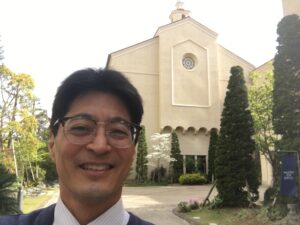
Anaheim University Graduate Interview – Ryan Fujii
1) Why did you choose Anaheim University? I chose Anaheim University for several reasons. First, I heard about the program through a colleague who did the program a few years back and recommended the program as she had a positive experience. Second, the program was setup by the well-recognized linguist, Dr. David Nunan, who has written many books on the subject matter. Third, the program had monthly opportunities to join and I was able to time it to coincide with what I thought would work smoothly into my school year schedule, which it did. Fourth, I like the idea of being able to study by distance learning but also having the opportunity to study with someone else who can relate to what I was thinking and writing about. Finally, the cost was very reasonable and I could afford it. 2) Why did you decide to study the Teaching English to Young Learners Certificate Program? I studied the TEYL Certificate program because over the last 21 years in Japan I have worked with young people teaching English and I had already taken the Cambridge CELTA certificate program geared for teaching adults. So, it seemed natural to take this course in addition to the fact that it was recommended to me by people at Anaheim University since I was working with elementary students already. 3) What did you like best about the program? What I liked best about the program was the integration of the readings from Dr. Nunan’s book, the video/lectures that supported the readings and vice versa, plus having Professor Marie Webb encouragingly responding to what I wrote and giving me further resources/thoughts to consider in my teaching. 4) How was the experience studying online? The online experience was very convenient and well-paced for my fairly busy schedule between Monday and Friday. The timing of the Thursday and Sunday deadlines for responses, discussions, and taking the quizzes for each unit was very reasonable. I felt like I could get into the rhythm of the schedule after a few weeks. The challenge was keeping up during the winter holiday when I fell behind. I was able to fortunately catch up in January with Professor Webb graciously encouraging me in the schedule to slowly but reasonably double up where and when I could, which I was able to do. Fortunately, I finished the course in time as originally scheduled and avoided any extra charges for an extension. I liked the video resources that supplemented what was being taught to reiterate or introduced new material for consideration, and were typically one hour or less. 5) Did you feel you were part of a learning community? As far as feeling a part of a learning community, I was the only student in my cohort, though once Professor Webb introduced one student from another cohort to contribute to my discussion section. With that said, I felt very fortunate to have such dedicated attention from Professor Webb in answering the questions or comments I wrote in response to the questions in the book designed by Dr. David Nunan. With the videos as well, I felt like I was part of a small community of teachers supporting my learning throughout the 15 weeks. 6) Can you tell us briefly about your career? After graduating from the University of Washington in Social Welfare, I furthered my studies at a technical school to learn drafting. I worked as an after-school daycare worker and Sunday school teacher during that time. After receiving my certificate in drafting, I worked three years at a civil engineering firm in Bellevue, Washington. Following that, I then worked at a middle school as a math assistant before coming to Japan on the Japan Exchange and Teaching Program, known as the JET Program. I came to Japan in 1996 and have been here ever since, having experience in public schools in a rural town and city teaching both elementary and junior high school students in the subject of English and cross-cultural exchange. Further, I worked at a private English conversation school, which was a private elementary/junior high/high school affiliated to a large university in Osaka. Since then I have worked at four more private schools teaching English to elementary, junior high, and high school students. I am currently working at a private Christian elementary school and at a couple of YMCA locations where I teach English. From this May and June, I will begin teaching a business class too, with a company called ECC. I never thought I would be here in Japan for so long, but it has become home for me since I got married in Japan and have two children nearly grown up now. Thank you for reading this rather long response. It was supposed to be brief. 7) Do you feel the TEYL Certificate will help your career? I feel the TEYL Certificate will help my career as there were many things I studied that relate to my classroom experiences. Both the theories of linguistics and practical skills studied are important aspects of the program that was complementary and balanced. 8) Who would you recommend these programs to? I would recommend this program to anyone teaching young learners English or preparing to teach in any part of the world. The material is rudimentary and a good foundation to build on for new teachers and a good refresher for those who have taught young learners, but would like to formally study or review linguistic theories and practical techniques. 9) Do you have any advice for new incoming students to the program? In terms of advice, I found it helpful to take notes during the video and stopping when necessary and even backing up several times. Also, highlighting the book helped me. I needed a paperback book and ordered a book, though it came during my second week of studies. If you are like me and need a paperback version to highlight and write in, I would suggest ordering a copy well in
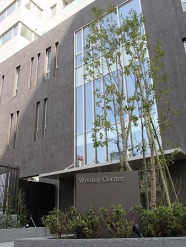
2018 Anaheim University TESOL Residential Session & MECTokyo
Anaheim University will hold the 2018 TESOL Residential Session from Thursday, August 2nd to Sunday, August 5th, 2018 at the Wesley Center in the Minami Aoyama area of Tokyo, Japan. Anaheim University’s M.A. and Ed.D. in TESOL students from around the world will attend sessions related to “Analyzing Language for Content and Form” led by Anaheim University’s Ed.D. in TESOL Program Designer Dr. Rod Ellis, Ed.D. in TESOL Program Director Dr. Hayo Reinders and TESOL Professor Dr. Jo Mynard. The Master of Arts in TESOL sessions will focus on “Analyzing language for content” while the Doctor of Education in TESOL sessions will focus on “Analyzing learner language” and students from both programs will also gather for group activities. On Saturday, August 4th, 2018, the Multicultural Education Conference in Tokyo (MECTokyo) will be open to the public. Co-organized by Anaheim University, the theme of the presentations will be “English Opening Doors”, covering a range of topics of importance to English language teaching and teaching English to young learners. Plenary presentations will be given by Anaheim University TESOL Professors Dr. Rod Ellis and Dr. David Nunan and experts on Applied Linguistics and TESOL will be featured including Keio University Professor of English Dr. Yuji Nakamura. The keynote presentation will be given by Marin Minamiya, who is a Guinness World Record holder for being the world’s youngest mountain climber to climb the highest peak (including Mt. Everest) on all seven continents as well as reach the North and South Poles. These workshops are part of Anaheim University’s online graduate degree programs in TESOL: Online Master of Arts in Teaching English to Speakers of Other Languages (MA in TESOL) Online Doctor of Education in Teaching English to Speakers of Other Languages (Ed.D. in TESOL) 4-Day Residential Schedule Thursday, August 2: 9:00 am to 5:00 pmFriday, August 3: 9:00 am to 5:00 pmSaturday, August 4: 9:00 am to 5:00 pm (MECTokyo)Sunday, August 5: 9:00 am to 12:00 pm Sat. May 4 MECTokyo Schedule 9:30 am – 10:00 am Dr. Yuji Nakamura: “Two Sides of the Same Coin: Teaching and Testing”10:00 am – 10:50 am Dr. Rod Ellis: “Teacher-Preparation for Task-based Language Teaching”11:00 am – 11:50 am Dr. David Nunan: “Seven Things I Wish I’d Known…”11:50 am – 1:00 pm “Teacher Education and Professional Training” Panel Discussion with Dr. Rod Ellis, Dr. David Nunan, Dr. Yuji Nakamura & Dr. Masahiko Abe. Moderator: Dr. Hayo Reinders 2:00 pm – 3:00 pm “Making an impact in our institutions / the field: the benefits of getting a graduate degree” Student Panel Discussion3:00 pm – 3:20 pm Announcements3:30 pm – 4:30 pm Marin Minamiya: “Reaching for Greater Heights” 1-Day MECTokyo Conference: 1,500 Japanese Yen The fee to attend MECTokyo on Saturday, Aug. 4, 2018 is 1,500 yen. 4-Day TESOL Workshop Registration: $1,200 Note: This fee covers the TESOL workshop commencing on August 2nd and concluding on August 5th and includes attendance at MECTokyo. Click here to register for 4-day TESOL Residential Session Master’s Level: Analyzing Language for Content Topics in this master level TESOL workshop include: Introduction to methods for collecting and analysing language for content Introduction to methods for collecting and analysing language learner data Narrative inquiry for teaching and learning histories The TESOL professional – micro-consultations Teacher and learner autonomy Using visual narratives and other visual tools in research Enhancing your career Preparing for presentations with individual feedback Group poster session presentations of content analysis Group poster session presentations of language analysis Doctoral Level: Analyzing learner language Topics in this doctoral level TESOL workshop include: Advanced methods for collecting analysing language learner data Advanced methods for collecting and analysing language for content Interaction analysis The TESOL professional – micro-consultations Fluency, accuracy, complexity Learner corpus data and learning analytics Task performance as engagement Preparing for presentations with individual feedback Group poster session presentations of content analysis Group poster session presentations of language analysis Pre-Requisites Master’s Level Workshop: Participants must hold an undergraduate degree from an accredited institution. Non-native English speakers must meet the English requirements outlined here. Doctoral Level Workshop: Participants must hold a masters degree in TESOL or Applied Linguistics or a related area of Education from an accredited institution. Non-native English speakers must meet the English requirements outlined here. MecTokyo: No Pre-quesisites Rod Ellis, Ph.D.Anaheim University Doctor of Education in TESOL Program Designer, TESOL Professor Dr. Rod Ellis is a distinguished thought leader in the field of Second Language Acquisition. Prof. Ellis received his Doctorate from the University of London and his Master of Education from the University of Bristol. A former professor at Temple University both in Japan and the US, Prof. Ellis has served as the Director of the Institute of Language Teaching and Learning at the University of Auckland and has taught in numerous positions in England, Japan, the US, Zambia and New Zealand. Dr. Ellis, who is known as an expert in Second Language Acquisition, is author of the Oxford University Press Duke of Edinburgh Award-Winning Classic “The Study of Second Language Acquisition”, as well as numerous student and teacher-training textbooks for Prentice Hall and Oxford University Press, Prof. Ellis’s textbooks on Second Language Acquisition and Grammar are core textbooks in TESOL and Linguistics programs around the world. MECTokyo Sat, Aug. 4 10:00 am – 10:50 am: Teacher-Preparation for Task-based Language TeachingIn this talk I will discuss the various impediments to the implementation of TBLT in state schools in Asia. This provide the basis for arguing the need for well-thought out teacher preparation programmes. Previous evaluation studies of such programmes have pointed to a number of factors that are the key to their success. Drawing on research in teacher education more generally I identify a number of general principles that can guide the design of preparation programmes. Following a discussion of various proposals for the development of teacher preparation programmes for TBLT, I outline an introductory course designed to provide teachers with the concepts and tools needed to implement TBLT in their own classrooms. Finally. I acknowledge some impediments are likely to remain. Policy makers may mandate
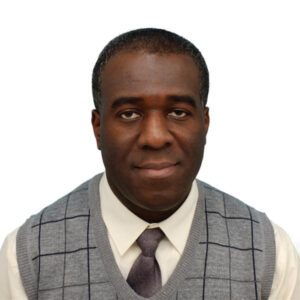
Anaheim University Graduate Interview – Paul Watson
1) Why did you choose Anaheim University? Basically, because of 5 key reasons: The professional and kind staff Accreditation Researched based and relevant academic programs Competitive cost Practical payment system Its online MBA and DBA Programs are practical, modern and relevant Its Accreditation – nationally accredited by the Distance Education Accrediting Commission (DEAC) Its Professors – all of whom are qualified with terminal degrees and real life practical experiences Its Ongoing Enrollment System – prospective students can start at the beginning of any term Its Accessibility to the Professors – we have access to the Professors’ contact info, who usually have a quick response rate Its Cost – quite reasonable especially compared to other institutions Its many modes of payment – a one-time payment system, per term payment, or pay in installments through a formal promissory agreement. About the Staff- I remember when I was enquiring many years ago about the program and the university. I had many questions, but the administrative personnel were always kind, patient, and informative. I thought that should I choose this university, I would then feel comfortable as there will be professional staff who will be able to assist me anytime. Anaheim’s academic, administrative, and technical staff are all professional. They really serve by the university motto: Student First, Always. 2) Can you tell us briefly about your career? I am a qualified foreign language Instructor. I have a BA in Spanish, a Post Graduate Foreign Language Teachers’ Diploma, an MBA from Anaheim, and presently pursuing my DBA also at Anaheim. I have over 20 years of teaching experience at all age levels, teaching Spanish, French and Maths in Jamaica, and EFL in Japan. My wife and I have been managing a small English Conversation school here in Japan, and I have just been offered a part time EFL lecturing position at a University in Japan. I have been President of many Organizations, including President for Okayama Association of Japanese English Teaching Programme (Okayama AJET) and President of Jamaica Spanish Teachers’ Association. During my tenure in these positions, some of my roles included liaising with different Ministries of Education (Education Officers/Consultants). For example, Jamaica’s Ministry of Education, Okayama Board of Education, diplomats, University lecturers, teachers and students, for the promotion of foreign language education in the respective regions. 3) Why did you choose to earn an MBA? I have been a teacher all my life. I thought that a business qualification would give me more opportunities and marketability. 4) Why did you decide to pursue a DBA? I am interested in academia and teaching at the university level. In addition, I am interested in having and running a business. I thought that pursuing a DBA would give me the choices of being a University Lecturer/Professor, heading an educational institution, managing a private corporation or running my own business. I have even known people who have done all or most of the above in their lifetime, so if the DBA can give me that platform, then why not? 5) What did you like best about the program? First, the research aspect and secondly, the stimulating discussions. Almost every week we have to research and investigate a business topic and turn in a formal report. It’s basically learning by researching and seeking ways to apply the knowledge in the real business world. In addition, our daily student-led online discussions and the Real-time online classes with the Professors provide the opportunities for stimulating discussions with a diversified student population. We can share on various business topics in a respectful manner. The interesting thing is that we can hear different viewpoints from peoples with different cultural, educational, and working backgrounds. This helps to make the leaning process quite engaging. 6) What is your favorite memory from the program? The program is so practical and knowledge based that I was able to a research assignment on an NPO where I worked, and use the knowledge which I learned to implement some changes in the organization. 7) How was the experience studying online? In a nutshell – Superb! Challenging! Engaging! Enlightening! Fulfilling! It can be challenging but overall a wonderful and rewarding experience. I remember the proud moment getting my transcript after finishing the MBA. I felt it was worth it! 8) How do you balance the time required to study while working full-time? It’s very difficult. I am not going to lie. When you have a paper or two to write every week, a 40-hour per week full time job, family, and community commitments, it can be daunting. Many times I wanted to give up, but it takes personal commitment, determinations and family support to finish the program successfully. I have to literally make a conscious decision on a regular basis how much time I have to set aside for my studies. After a while, it becomes a routine. 9) Do you feel you were part of a learning community? Yes, the online discussion board and real-time classes help us students to always present and share our different points of view, whether you choose to do so in a relaxed manner or formal academic register. 10) What was the most unusual location you joined an online class or discussion forum from? At a Wedding Center. I remember once I had a real-time online class, but it clashed with my wedding invitation. I did not worry because the good thing about Anaheim’s system is that I could arrive early at the wedding, sit in my car in the parking lot, log into the system, join the class, participate in the discussion, and afterwards was just in time to participate in the wedding without missing a beat. 11) What would you say to someone who is hesitant about studying online? Yeah, I would understand their feelings. I was hesitant too at first but now I have no regrets. Online studies are convenient, where you have the ability to study while working full time. It’s recognized just the same as classroom style learning. There
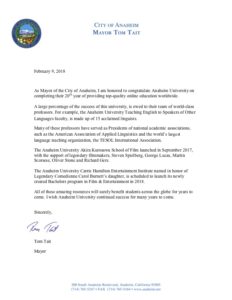
Anaheim Mayor Congratulates Anaheim University for 20 Years of Quality Online Education
Anaheim University was honored to receive this letter of congratulations from the Mayor of the City of Anaheim, Tom Tait, for Anaheim University’s 20 years of “providing top-quality online education worldwide”. With a juris doctorate degree and an MBA, Tom Tait has served for over 10 years on the Anaheim City Council and is in his second four-year term, which began in 2010, as the mayor of Orange County’s most populous city, while also serving as the CEO of an engineering and environmental services firm. He spearheaded Anaheim’s program to help the homeless and introduced “Drug Free Anaheim,” a program that encourages chronic drug users to ask for help at Anaheim police stations in exchange for a free ride to a rehabilitation center. He has also worked toward improving relations between the Anaheim police and residents. His “City of Kindness” initiative was instrumental in His Holiness the Dalai Lama choosing the city of Anaheim to celebrate his 80th birthday in July 2015, as well as in bringing together thought leaders for the Global Compassion Summit in Orange County, California. Celebrating its 160th anniversary in 2017, the City of Anaheim is one of the nation’s premier municipalities and California’s 10th most populous city. Located in Orange County, California, 28 miles southeast of Los Angeles, Anaheim covers 50 square miles with more than 346,000 residents, and has established sister-city relationships with Mito, Japan and Vitoria-Gasteiz, Spain. The municipal corporation’s annual budget is $1.6 billion. Anaheim supports a thriving business community with companies such as Disneyland Resort, CKE Restaurants, Inc., L-3 Communications, and Pacific Sunwear. Successful sport franchises including the Los Angeles Angels of Anaheim Major League Baseball (MLB) team, the Anaheim Ducks National Hockey League (NHL) team, the USA Men’s National Volleyball Team call Anaheim home. Anaheim also boasts world-class meeting and entertainment venues with the Anaheim Convention Center, the largest on the west coast, Honda Center, The Grove of Anaheim and Angel Stadium of Anaheim. Anaheim is ranked one of the safest cities in the nation and annually welcomes millions of visitors to the city, truly making it where the world comes to live, work and play.

Full MBA Scholarships: Apply by May 25, 2018
Anaheim University Ferrotec Akira Yamamura Scholarship 2 students can earn a full scholarship towards an Anaheim University online Master of Business Administration (MBA) degree program Applicants can apply the scholarship to 1 of these 3 online degree programs: Online International MBA Online MBA in Global Sustainable Management Online Master of Entrepreneurship Applicants must meet Anaheim University’s MBA entrance requirements. Applicants must express an interest in being considered for future employment by Ferrotec. However, being awarded a scholarship does not guarantee that an offer of employment will be made to the scholarship recipient. Applicants with Heat Transfer, Physics, Chemical Engineering, Mechanical Engineering, International Business / bilingual (English + 1 other language) language skills/experience will be given preferential consideration. Scholarships will be awarded on a merit basis based on the applicant’s qualifications. Applicants must maintain standards set forth by the Scholarship Committee and/or the University’s administration in order to remain in good standing and continue to receive the scholarship funding throughout the remainder of their program. Scholarship recipients are expected to maintain a minimum of a B average at all times and complete each course with a minimum of a 3.0 grade. Scholarship recipients must also remain continuously enrolled from the commencement of their program through graduation. Skipped term fees are not included in the scholarship and skipped terms are only allowed with special permission from the University’s Dean. Scholarship Application Requirements Scholarship Applicants must submit: – standard application materials required for an Anaheim University online MBA or Master of Entrepreneurship program. Click here for a list of program entrance requirements. – a 1,000 word essay outlining: How you feel the Anaheim University degree will benefit you Why you would like to be considered for possible employment by Ferrotec upon graduation Your area of academic and professional specialization To Apply: Click here to complete the online application form. E-mail 1,000-word scholarship application essay to ausupport @ anaheim.edu Application Deadline May 25, 2018 Scholarship Recipients Announced June 1, 2018 MBA Program Start Date July 2, 2018 About Ferrotec Founded in 1980, Ferrotec is headquartered in Tokyo, Japan with locations in Japan, U.S.A., China, South Korea, Taiwan, Malaysia, Singapore, Germany, Spain, France, Italy, and Russia. Ferrotec is a diversified technology company with a worldwide presence in a broad array of end products, manufacturing systems, and industries. Ferrotec provides its customers with advanced material, component, and assembly solutions that make their products work better, more precisely, and more reliably. Founded on a technology core of Ferrofluid magnetic liquid and Ferrofluidic® sealing products, the company and its product portfolio have grown to meet the evolving needs of its customers. Ferrotec is now a global enterprise characterized by substantial intercompany cooperation in research, manufacturing and marketing of products. The Ferrotec Group contributes to society as a manufacturer, and a company whose progress brings joy to its customers, shareholders, employees, business partners, the community, and all of its stakeholders. Ferrotec has grown to what it is today through the pioneering and innovative spirit of its President and Representative Director Dr. Akira Yamamura About Dr. Akira Yamamura Dr. Akira Yamamura, who is an Executive Advisory Board member of Anaheim University, established Ferrotec with two people in 1980. At the time, he was president of the Japanese subsidiary of Ferrofluidics Corporation, after joining the company as an engineer. In 1987, he led a management buy-out of the company and then in 1999 acquired the former parent company. Dr. Yamamura has grown Ferrotec to become one of the most important companies in the electronics industry, with annual revenue growing to approximately US$680 million, 27 subsidiaries and more than 5,400 employees in Japan, the US, Europe and Asia. The original business of the company was distributing Vacuum Feedthrough, which applies Ferrofluid, magnetic field. Vacuum Feed-through is a key component to shield the vacuum environment, and utilized in semiconductor equipment, single crystal silicon ingot grower, FPD equipment, and thin film equipment for photovoltaic application. In 2012, Dr. Akira Yamamura was ranked #24 in Ernst & Young’s “World Entrepreneur of the Year” awards.

Anaheim University MBA Graduate Interview – Thanh-Phong Huynh
1) Why did you choose Anaheim University? After thorough research, my decision for Anaheim University was based on three major reasons: First: flexibility. As I am permanently employed and studying for a second Masters degree simultaneously, my place of work and time schedule were subject to constant changes. If it was not for a fully online-based program, I would not have been able to juggle three “full-time jobs.” Second: internationality. A German degree in Humanities alone is insufficient to cope with the increasing importance of globalization and transculturalism. As a nationally accredited and English-speaking university with international orientation, I felt that Anaheim University fully met the requirements. Last: uniqueness. With particular attention to the International MBA program, Anaheim University is practically the only online university in the United States which combines business knowledge with strong expertise in Asian studies (special thanks to Dr. Callahan!), which is among my main research interests. 2) Can you tell us briefly about your career? At the age of 16, I underwent a three-year apprenticeship as an IT Management Assistant in the financial sector. Afterwards, I finished my compulsory civilian service for the Red Cross, thus switching over to the tertiary sector. Upon completion, I attended university to study Chinese and Japanese Studies (and later the International MBA), while at the same time co-managing a boutique hotel and working for NHK WORLD. Now I strive to both do a Doctoral degree in Asian Studies and apply for a management job position. 3) Why did you choose to earn an MBA? If it was not for earning a living, I would be perfectly satisfied with studying humanities only and fully dedicating myself to academic research. The MBA was meant to function as my alternative key qualification to enter the free market, in case I failed the academic path. However, in the course of tackling the MBA program, I realized that earning a MBA degree not only increases your job chances and round out the overall picture, you also acquire analytical and organizational skills that are useful for interdisciplinary approaches. Whether as a complement or a stand-alone degree, there are only advantages one can derive from earning an MBA. 4) How do you feel completing the program successfully? Nothing in particular. Just moving on to the next chapter in my life. 5) What did you like best about the program? Honestly, Student Services was the best! Extremely helpful, always friendly, casual communication, fast replies and great dedication (special thanks to Elizabeth and Shizuka). 6) What is your favorite memory from the program? Whenever I received an enrollment key for accessing a new course, I burst with curiosity about the assignments and tasks we had to do over the upcoming six weeks. Upon taking a quick look, I immediately checked the new student list to see with whom I would study together. I personally enjoyed these moments most. 7) How was the experience studying online? As I was also studying at a traditional university, I see great differences compared to studying online. The most outstanding difference in my opinion (taking traditional German universities as a base for comparison) is that you have a strict point system. Thus, you will be forced to actively participate, engage in discussions, and meet deadlines (with exceptions being granted if there is a good reason for it) on a weekly basis. Most students in an “offline seminar” usually do not talk because they are either shy, afraid of saying something wrong, or have language problems. However, these types of students would contribute on an online platform and you can see their potential being drawn out. Naturally, most feel more comfortable with writing instead of speaking. You have time to think about what you want to say. There is no pressure at all. For further discussions, webcam seminars are held twice per course, where you can exchange your ideas and further elaborate on your thoughts with the professor and the group. If that is still not enough, you just arrange private sessions with your classmates which I did a lot. All in all, studying online is way too underrated. It can be efficient and productive in so many ways that traditional universities cannot keep up with. It was definitely worth the experience. 8) How did you balance the time required to study while working full-time? It is all about setting priorities. Anything can be overcome with self-discipline, perseverance, and effort. 9) Did you feel you were part of a learning community? Yes, advancing towards the completion of a course alongside my – best described with the Japanese term – “nakama” (“comrades” with a slightly deeper meaning) was the greatest feeling. Although everyone is scattered around the world, you feel connected with them. You give and receive support. You never have the feeling of being a lone wolf. 10) What was the most unusual location you joined an online class or discussion forum from? A Sushi bar in Shinjuku. 11) What would you say to someone who is hesitant about studying online? Give it a chance. 12) Do you feel the MBA will help to develop your career? Not only career, but life experience as well. 13) What advice would you offer to the Anaheim University incoming students? Don’t underestimate the workload. The degree has to be earned, in the literal sense of the word.
Anaheim University Graduate Interview – Bethany Fazekas
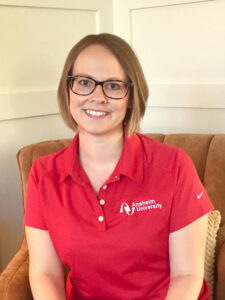
Bethany Fazekas graduated with honors from Anaheim University in 2012 with a Master of Arts degree in Teaching English to Speakers of Other Languages. 1. Why did you choose Anaheim University’s MA in TESOL program? I chose Anaheim University’s MA in TESOL program for the convenience of the online course setup, the outline of classes offered in the program, and because I was excited to learn directly from professors I had read about in my undergraduate program. I had studied their research and was anxious to have them teach me in the MA program! Their vast, global experiences were something I did not take for granted. 2. Can you tell us about your career to date? I have taught for 9 years in the public-school setting. I have taught ESL in Pennsylvania and English and Writing in Texas–grades ranging from 4-12! I am also beginning to tutor international students at the college level, which is very exciting. 3. How has your Master’s Degree helped you to further your career? Besides giving me a vast background in second language acquisition, I have been able to use a lot of the content I studied in the various courses at AU. For example, I served on a curriculum committee for 5 years. I was well prepared, because I had taken the curriculum design course–EDU 580 at AU. In general, my research at Anaheim has encouraged me to think outside the box in my classroom. Research in any area of education has a life-long impact because it affects our teaching practices, which in turn affects student learning. 4. Can you share a favorite memory from Anaheim University? That’s easy! By far, the best memories from Anaheim were attending the residentials and meeting the professors and my classmates face to face…learning with them, engaging with them, exploring with them. I never would have guessed I would get on a plane by myself and travel to Seoul, South Korea, for a graduate program. I did it, and it was one of the most thrilling experiences in my life to date! 5. Did you have a favorite class at Anaheim University? I enjoyed many of the classes, but I think my favorite was EDU 600 (my research portfolio) because it’s where everything came together for me. I pulled together everything I learned into one qualitative research project on freewriting. I felt supported and led by Dr. David Nunan throughout the entire course. It was just a very gratifying class, and I was proud of my work in the end. 6. How did you enjoy the online experience? If I had to describe the online experience in a word it would be: fun. There was always a fun element to each course. The online platform at AU is different than in other places. AU professors work hard to make sure the classes are extremely interactive. Honestly, it felt like I was sitting in a classroom with my classmates many times. It was just very interactive and engaging. 7. Who would Anaheim University’s MA in TESOL program best suit? I would recommend this program to anyone who is currently teaching ESL. This program can help expand your knowledge on TESOL, and it gives you a lot of practical tips for being successful in the classroom. 8. What were the challenges in your program? The biggest challenge was producing an entire 100-page paper/project with 2 other people. We lived in different parts of the world! We gathered data, designed, e-mailed, disagreed, edited, revised, etc. back and forth for months to complete this project. However, in the end, we had designed an entire curriculum– long-distance! This was for EDU 580. The class challenged me in so many ways, and I definitely grew because of it. 9. In your opinion, how does learning TESOL improve careers for ESL teachers? I think if you currently have a classroom, it will allow you to step back and really reflect on your current teaching. I was able to ask myself if I was really meeting the needs of my students and if there were ways I could better myself as a teacher. I even used my classroom as a research study! I started keeping a teaching diary. It improved the way I design materials and deliver content. 10. Which residential sessions did you attend and what did you like best about them? I attended the Seoul, South Korea, residential in October 2010, and also the Anaheim, California residential. I liked finally getting to meet the professors in person. It was a great opportunity to bring your questions and your comments in front of your professors and classmates and be able to process everything we had discussed online. The sessions were always engaging, and Anaheim did a great job at planning some surprise social elements into the sessions…gathering for a meal, watching fireworks at Disney, even celebrating Dr. Nunan’s birthday with a big chocolate cake in a restaurant in South Korea! The residentials are the highlight of the program! 11. How did you feel connected to your learning community? The discussion forums kept you connected all the time. You are networking with people all over the globe. The professors were very accessible, too. 12. What advice can you give to new students entering the MA in TESOL program? First of all, congratulations on deciding to pursue your MA in TESOL. It is a great decision. I would say to start by keeping a notebook with your questions from the very beginning… questions about your courses, your research, your goals, your current classroom, your methods, etc. These questions will help guide and direct your eventual research project and/or thesis. Also, don’t be afraid to change your ideas. Sometimes where you think you are going ends up being entirely different than where you actually go. When you carry out research, you have the power to shape it and mold it and make it show you something you never knew existed. Finally, make the program personal. Make it
Anaheim University Graduate Interview – Craig Reiter
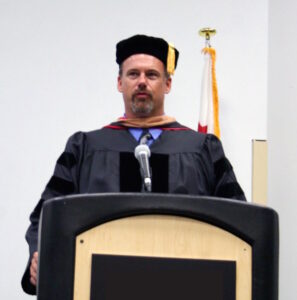
Q. Why did you choose Anaheim University? I chose AU for my MBA because it was one of the few online programs for Sustainable Management. My research on the program found that the faculty were global experts on Sustainability and Corporate Responsibility. Having completed the program, I can attest that it was even better than I had anticipated. Q. Why did you choose to pursue a DBA after you completed your MBA with Anaheim University? I chose to pursue a DBA because I want to be a Professor and teach sustainability at the graduate level to business professionals. I also want the credibility in the industry and at my company as a sustainability professional. Q. What do you like best about the program? What I liked best about the program was analyzing case studies for sustainability solutions that have been tried, tested, and proven to be viable options for reducing negative impacts. Studying these examples and working through the challenges in class helped me develop new solutions that I have implemented at my company. Q. What is your favorite memory from the program? Finishing the program was my favorite memory. It was a lot of work but very rewarding. Q. How did you feel attending and speaking at the 2017 Graduation Ceremony? Speaking at the graduation was such an honor. I am proud to be part of the AU Alumni and I love telling others how AU helped change my career and my life. I have to admit, I really liked being introduced as Dr. Reiter. Q. Please describe your experience with studying online. Online studying was nice because it was flexible with my demanding schedule. However, it requires a lot of self-management and dedication to stay on track. As with any graduate program, there is a lot of writing, reading, and research every single day. You cannot let yourself fall behind or it will be very difficult to recover. Stay the course and it’ll be over before you know it. Q. Do you feel you are part of a learning community? I absolutely feel that I am part of the learning community. Clearly it is not the same as going to a brick and mortar university, but I received all the perks of getting a great education from Anaheim University. Q. What was the most unusual location where you joined an online class or discussion forum? I was on vacation in Palm Springs getting ready to go to a fancy dinner. While I was under pressure to get the online class done, it turned out to be one of the best lectures I’ve heard on greenwashing. I’m glad I didn’t miss it. Q. What would you say to someone who is hesitant about studying online? I would tell someone to thoroughly think about what it will take to complete the degree. Ask yourself if you have the time to drive to and from a traditional college campus and sit in lecture halls for hours on end? For me, the answer was no. There is no way that I could maintain my job requirements and attended college full time. I choose the online MBA and DBA programs at AU and it has made all the difference. Q. Please tell us briefly about your career. I am currently the Executive Vice President and Chief EHS&S Officer for a medium-size General Contractor and Sustainable Construction Consulting firm. Prior to my current position I was Sr. Principal Advisor for Strategy and Sustainability at Edison International. Q. Do you feel the MBA has helped your career? How will the DBA further your career? My MBA helped me get an Executive position with a higher salary. The DBA will help me become a professor and expert in sustainability. Q. Do you think the field of sustainable management is becoming more important in business? What are the merits to studying sustainable management? Sustainability is not a question of “if”, but “when.” Most large corporations have realized the benefits of being sustainable and those that haven’t will be forced to either by regulations, shareholders, and/or stakeholders. If your goal is to be in business and manage sustainability, then learning how to actually “manage” sustainability is the direction you want to take. Studying sustainable management will give you the skills to manage companies from a triple bottom line where profits, people, and the planet are all factored into the decision making of the corporation from the top down.