
Master of Fine Arts in Digital Filmmaking (MFA)
June 6, 2023 2026-10-05 6:00Master of Fine Arts in Digital Filmmaking (MFA)
Master of Fine Arts (MFA) in Digital Filmmaking
Turn your creative vision into professional filmmaking. Designed for aspiring filmmakers worldwide, this online MFA from the Akira Kurosawa School of Film, taught by Hollywood-based professors in live webcam classes, develops your storytelling, production and post-production skills through to a creative thesis project.
Online
Live weekly webcam classes
About 3 years
While working full-time
56 credits
12 courses + thesis
1 week
In-person residential
DEAC
Accredited
Why Choose the MFA in Digital Filmmaking
Four reasons filmmakers choose the Akira Kurosawa School of Film.
Learn From Industry Professionals
Study with professors based in Hollywood and other leading film markets without relocating.
Hands-On Residential
Spend one week in Hollywood or Tokyo working with professional equipment and industry professionals.
Choose Your Specialty
Select electives in documentary, animation, producing for the web, game design or story structure.
Live Webcam Classes
Weekly live classes with your professor and classmates around the world.
Program Learning Outcomes
What you will be able to do by the time you complete the program.
Film & Media Studies
- Situate film and media within artistic traditions from many countries
- Understand the central place of Akira Kurosawa in world cinema
- Review how cinematic media are produced, distributed and consumed
Critical Writing & Research
- Produce critical work on film and media using appropriate critical theories
- Summarize significant research findings in the field
Creative Practice
- Produce creative work that explores interior and exterior journeys of understanding
- Develop creative writing to the professional standards of the film and media industries
Production & Industry
- Use cutting-edge techniques and technologies to produce digital media
- Gain the intellectual and professional background to enter the cinematic marketplace
How You'll Learn
Each nine-week course combines a weekly live webcam class, an ongoing discussion forum, weekly readings or film critiques, and a course film project, screenplay or research paper.
Your Path to the MFA
Coursework, a hands-on residential and a thesis project.
01
STEP 1
Core Courses
Film aesthetics, digital filmmaking, screenwriting, world cinema, film theory, the film business and post-production.
02
STEP 2
Electives & Residential
Three electives in your area of interest, plus a one-week residential in Hollywood or Tokyo.
03
STEP 3
Thesis Project
Begin your thesis after all other coursework; it takes about two terms to complete.
Career Paths
Build a career in film, media and digital content.
DIRECTING & PRODUCING
Make Films
Develop, direct and produce your own work.
- Director
- Producer
- Independent filmmaker
WRITING
Tell the Story
Write for film, television and digital media.
- Screenwriter
- Story developer
- Script consultant
POST-PRODUCTION & CAMERA
Craft the Image and Sound
Specialize in the technical side of filmmaking.
- Editor
- Sound designer
- Cinematographer
DIGITAL MEDIA & TEACHING
Create and Teach
Work across web, documentary and games, or teach film.
- Web or documentary producer
- Animation or game content creator
- Film and media educator
Meet Our Faculty
Learn from experienced academics and professionals who bring subject expertise, research, and real-world perspective into the classroom.

David Desser, Ph.D.
Professor Emeritus and Founding Dean of the Akira Kurosawa School of Film. Has taught at the University of Southern California and UCLA.

Vikram Channa
Associate Dean of the Akira Kurosawa School of Film, and a Vice President at Warner Bros. Discovery.
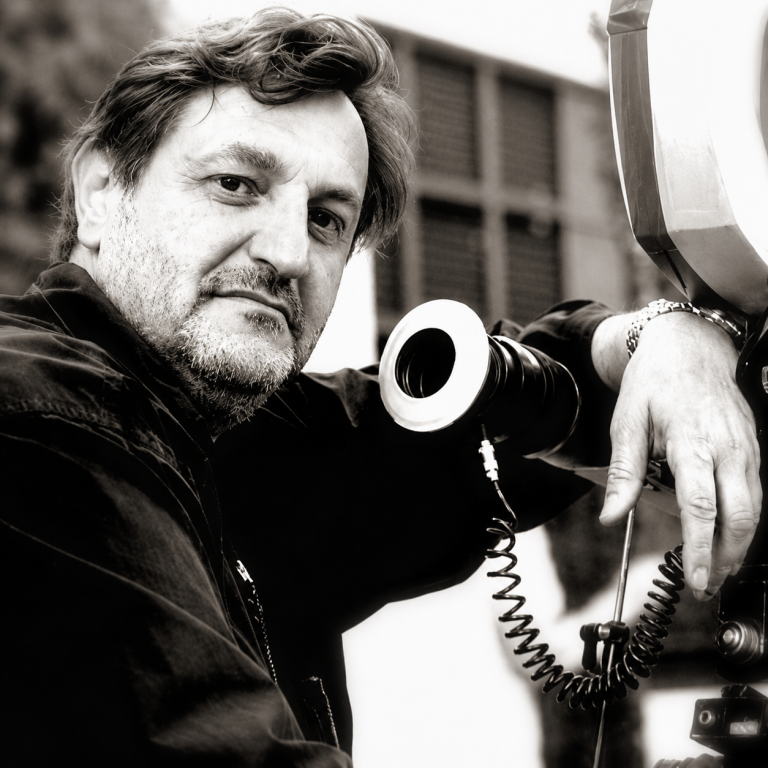
Henryk Cymerman, MFA
Cinematographer. His credits include Star Trek: First Contact.

Alison Marek, MFA
Award-winning writer and director. MFA, New York University.
Ready to Start Your MFA in Digital Filmmaking?
Speak with an advisor about your creative goals and experience, or start your application today.
MFA in Digital Filmmaking Curriculum
The Master of Fine Arts (MFA) in Digital Filmmaking through Anaheim University’s Akira Kurosawa School of Film is comprised of 14 courses — nine core courses, three electives, and a two-term thesis project — for a total of 56 units. Each course carries four units and runs for nine weeks, with a new course beginning every ten weeks.
The program can be completed in approximately three years. Alongside the online coursework, students attend one seven-day in-person Residential session in Hollywood or Tokyo for hands-on experience with professional equipment, and complete an original thesis film or project that may be submitted to festivals.
Each course is nine weeks long and carries four units, and a new course begins every ten weeks. The 56 units above are the nine core courses (including the two-term thesis project), two Group A electives and one Group B elective. Attendance at a one-week in-person Residential session in Hollywood or Tokyo is required for graduation; its tuition is included, but students pay their own travel, room and board. The maximum time allotted to complete the program is four years.
Coursework and Thesis
Nine core courses ending with a two-term thesis, two electives from Group A, and one from Group B. Open any course to read its full description.
Core Courses
The nine core courses taken by every MFA student, from Kurosawa and film aesthetics through digital filmmaking, screenwriting, world cinema, theory and post-production. The thesis project is taken separately, after all coursework is complete.
An examination of selected films of Akira Kurosawa from the point of view of their origins in global culture and their impact on international film culture. The course focuses on films that clearly interact with world cultures and that have been overtly remade, concentrating on transnational culture, intertextuality and reception, with film viewing, critical and source readings, and research papers.
An in-depth analysis of the particular aesthetic features of film, with some consideration given to television and video. Aspects such as mise-en-scene (lighting, camera position and movement, sets, props, costumes), editing, sound, and narrative structure are considered.
A fundamental understanding of the digital filmmaking process from pre-production through production to post-production and delivery. Through lectures, screenings and hands-on learning, students learn the jobs of each crew member and the fundamentals of screenwriting, casting, working with actors, camera techniques, directing and editing, taking a film project from inception to completion.
Building on Intro to Digital Filmmaking, this course gives a more advanced understanding of the digital filmmaking process across development, pre-production, production and post-production. Students plan, develop, shoot and edit a final narrative project. (Requires MFA 520.)
An introduction to the principles of screenwriting, with special attention to traditional cinematic narrative, dramatic plot and structure, scene design and character development. Combining lectures and intensive workshops, students analyze short films and peers’ drafts, complete screenwriting exercises, and write a short screenplay.
An introduction to the history of world cinema from the invention of the medium to the present, focusing largely on films made outside the Hollywood system and how international cinema has interacted with the American industry, and examining the impact of industrial, economic, technological and social change on cinematic storytelling.
A survey of critical methods used to study cinematic texts, engaging the major issues and debates surrounding varied methodologies including genre theory, authorship, psychoanalysis, semiotics, feminism, Marxism, Cultural Studies, reception studies, and post-colonialism.
Given the intertwined nature of filmmaking and media companies and the variety of business models possible, this course gives film and video makers a sense of how the business side of the equation operates.
Once production ends, the art and craft of finishing a film begins. This course examines both theoretical and practical approaches to post-production, with emphasis on sound and editing.
Thesis Project
The two-term thesis project, begun after all other coursework is complete. Students produce an original film or project that may be submitted to a film festival, in consultation with a thesis advisor.
This capstone project demonstrates a command of the learning outcomes of the writing and production courses and provides an opportunity to work on a project that may be submitted to a film festival. Length, genre and other aspects are determined by the student in consultation with the thesis advisor, over approximately two terms. Thesis students complete the CITI Social-Behavioral-Educational (SBE) Foundations certificate.
Group A Electives
Students select two Group A electives. Students may take either MFA 590 or MFA 591, but not both.
An intensive focus on the debates around and concepts of documentary/non-fiction cinema, tracing the history of documentary production and the critical and theoretical writing it has produced, and examining major filmmakers and movements in the non-fiction canon. Students examine one documentary in depth.
Students learn the fundamentals of documentary production — mode, style, technical and practical logistics, and aesthetic choices — then research, develop, produce, shoot, edit and deliver a short documentary project by the end of the class.
An examination of concepts, characters, and storyboards for basic animation production, with emphasis on creating movement and expression using traditional or electronically generated image movement.
A comprehensive understanding of how to use developments in web technology to create videos for online distribution — the history of streaming video, web video production techniques, aesthetics, editing for the web, compression and technical considerations, and social media and online marketing — applied to multiple online video projects.
A practical foundation in game design focused on concept development, design decomposition and prototyping. Using game design theory, analysis, physical prototyping, playtesting and iteration, students learn to translate game ideas and themes into gameplay, game pitches and design documents.
An advanced course building on introductory screenwriting skills, in which students develop original narrative screenplays for film, television and/or digital programming, focusing on structural elements from the hook and first act through the mid-point, climax and resolution, and adhering to industry standards.
Group B Electives
Students select one Group B elective.
An introduction to the latest theoretical models of genre theory, transnationalism and cultural flows, demonstrated by an in-depth analysis of a single global genre — possible topics include melodrama, horror, neo-noir, action, youth and the road movie.
A study of authorship — the demonstrable qualities of an individual filmmaker’s preferred style, approach to narrative, use of actors, and recurring characters, motifs and themes across a career — focusing on one or two globally important directors.
Program Requirements
Key requirements students complete as they progress through the degree and to graduation.
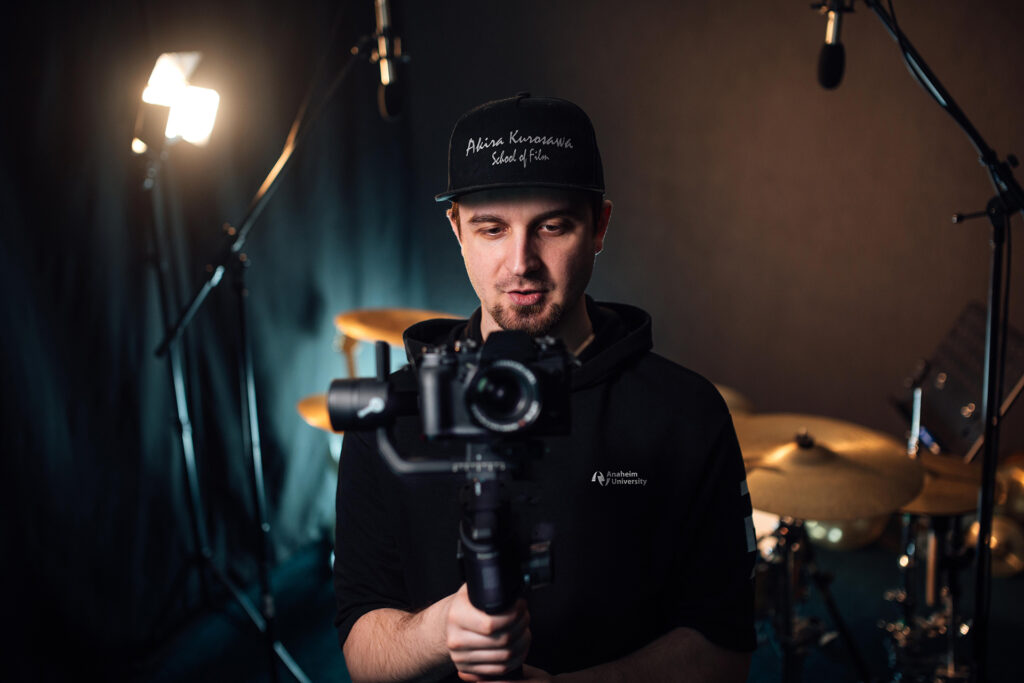
Attendance at one seven-day in-person Residential session at a facility in Hollywood, California or Tokyo, Japan is a requirement for graduation. Students gain hands-on experience with professional-grade motion picture and HD video equipment and learn from industry professionals. Tuition for the Residential is included in the program price, but students pay for their own travel, room and board.
All required courses must be completed before beginning the thesis. The thesis project (MFA 600) runs for approximately two terms and results in an original film or project that may be submitted to a film festival.
Students must maintain a 3.0 grade point average (GPA) throughout the MFA in order to graduate. Any student whose GPA falls below 3.0 is placed on Academic Probation and given two terms to bring it back to a 3.0 level. A grade lower than 80% on any course means the course must be repeated.
The maximum time allotted for completion of the MFA program is four years from the date of matriculation. Extensions require written approval from the Program Director, the Office of the Registrar, and the Office of Financial Affairs.
2026 Term Calendar
The schedule is set each year and usually announced in the fall. Plan ahead to take each required course when it is offered.
| Term | Dates | Courses offered |
|---|---|---|
| Term 1 | Jan 2 – Mar 4, 2026 | MFA 591Documentary Film Production |
| Term 2 | Mar 10 – May 12, 2026 | MFA 600Thesis |
| Term 3 | May 19 – Jul 21, 2026 | MFA 500The Cinema of Akira Kurosawa in Global Context |
| Term 4 | Jul 28 – Sep 28, 2026 | MFA 510Film Aesthetics |
| Term 5NEXT | Oct 6 – Dec 7, 2026 | MFA 520Intro to Digital Filmmaking |
Residential Session
One week in person in Hollywood or Tokyo, working hands-on with professional equipment and learning from industry professionals.
- Required
- 1 session during the program
- Length
- One week, 40 hours of instruction
- Where
- Hollywood, California or Tokyo, Japan, usually alternating between California and Asia
- What you do
- Work with professional motion picture and HD video equipment, with seminars, facility tours and lectures from industry professionals
- Topics
- Post-production, distribution and marketing; the business of screenwriting; video game development
- Session fee
- $2,200
- Housing & meals
- About $1,500 (estimated); travel not included
Plan Your Studies
A few rules that help you finish on time.
COURSE ORDER
Take Courses When Offered
Missing a course when it is offered can stop you finishing on time, and leaving your studies while a needed course runs can lead to dismissal.
GRADES
Keep a 3.0 GPA
You need a 3.0 GPA throughout the MFA. Below 3.0, you have two terms on academic probation to bring it back up.
THESIS
Your Thesis Comes Last
A two-term project you begin after all other coursework. You stay enrolled each term until it is approved.
TIME LIMIT
Up to Four Years
Most students finish in about three years. Extensions beyond four years need approval and carry a fee of $2,000 per term.
Ready to Start Your MFA in Digital Filmmaking?
Speak with an advisor or start your application today.
MFA in Digital Filmmaking Tuition & Fees
Tuition for the MFA in Digital Filmmaking is $2,000 per course, with a $200 records fee per term. The estimated total program cost is $35,375 and includes required tuition and fees, the residential session fee, estimated accommodation, textbooks, and a research reserve fund. The program is 56 units across 14 terms — nine core courses, three electives, and a two-term thesis project.
Students may pay tuition course by course and can also inquire about a non-interest-bearing monthly payment plan. The estimated total assumes completion within the standard 14-term program schedule (about three years) and successful completion of each course on the first attempt; repeated courses or additional enrollment may increase the final cost.

| Fee | Amount |
|---|---|
| Application fee non-refundable | $75 |
| Registration fee non-refundable | $100 |
| STRF fee (California residents only) non-refundable | $0 |
| Course fees | |
| Tuition — $500 per credit × 4 units | $2,000 / course |
| Records fee | $200 / term |
| Residential session fees | |
| Residential session fee (room, board & travel not included) | $2,200 |
| Estimated accommodation fees | $1,200 |
| Additional fees | |
| Estimated textbook fees | $1,000 |
| Research reserve fund | $1,500 |
| Transfer credit fee optional | $75 / course |
| End-of-program fees | |
| Original transcript | No cost |
| Each additional transcript copy optional | $25 |
| Diploma | No cost |
| Replacement diploma optional | $200 |
| Replacement cover optional | $100 |
| Program completion letter optional | $35 |
| Total cost of program | $35,375 |
Program Cost & Additional Enrollment
The estimated total program cost shown above assumes successful completion of all required courses on the first attempt and completion of all program requirements within the standard program schedule. Students who repeat a credit-bearing course will be required to pay additional tuition. Students who require enrollment beyond the standard program schedule to complete the thesis will be required to pay tuition and a records fee for each additional term of enrollment. The maximum time allotted to complete the program is four years from the date of matriculation. Some courses require the submission of an original film project; production expenses are the responsibility of the student and are not included in the program fees.
Residential Session
Attendance at a one-week, in-person residential at a facility in Hollywood, California or Tokyo, Japan is a requirement for graduation. At the residential, students gain hands-on experience with professional-grade motion picture and HD video equipment and learn from industry professionals. The tuition for the Residential Session is included in the total program price, but students must pay for their own travel, room and board; these costs vary by the student’s originating location and chosen accommodations. Students traveling to the residential should have travel insurance, and local students should have medical emergency insurance.
Equipment & Production Costs
Anaheim University is an online institution, and students supply their own production equipment — a camera capable of 1920×1080/24fps, lens(es), a digital sound recorder, basic continuous lighting, and non-linear editing software (Final Cut Pro or Adobe Premiere Pro). Production expenses for course film projects are the responsibility of the student and are not included in the program fees.
Research Reserve Fund & Textbooks
Students in Anaheim University’s online graduate programs are required to hold an additional research reserve fund — $1,500 for master’s students — for the purchase of journals, research materials, software and other resources specific to their studies. Students are not required to spend the entire fund, only the amount necessary to carry out their research. A student can also plan on approximately $1,000 in textbook purchases across the program; a textbook list is available in the online resources of the student website. The above itemizes all of the fees and charges for which the student is responsible; the refund policy is set out in the section on Policies & Procedures.
Student Tuition Recovery Fund (STRF)
The Student Tuition Recovery Fund (STRF) is administered by the California BPPE and applies only to California residents. The STRF fee is currently zero ($0) per one thousand dollars ($1,000) of institutional charges. The State of California established the STRF to relieve or mitigate economic loss suffered by a student in an educational program at a qualifying institution who is or was a California resident while enrolled, if the student enrolled, prepaid tuition, and suffered an economic loss. Unless relieved of the obligation to do so, you must pay the state-imposed assessment for the STRF, or it must be paid on your behalf, if you are a student in an educational program who is a California resident, or are enrolled in a residency program, and prepay all or part of your tuition. You are not eligible for protection from the STRF, and you are not required to pay the STRF assessment, if you are not a California resident or are not enrolled in a residency program.
Payment Terms
Each course is US$2,000.00 for tuition, excluding books, materials and other costs. The application fee must be paid at the time of application, and prior to beginning the first term students must pay the registration, tuition, and records fee. Students must pay the required tuition fee prior to commencing each subsequent course. Tuition may be paid course by course by check, credit card (Visa, Mastercard, American Express or Discover), money order or bank transfer (the student is responsible for any transaction fees imposed by the institution). To inquire about non-interest-bearing monthly payment plan options, email [email protected].
MFA in Digital Filmmaking Admission Requirements
Admission to the MFA in Digital Filmmaking is open to applicants ready for graduate study in film. Applicants must hold a bachelor’s degree from an accredited institution, meet the minimum 3.0 GPA requirement, and provide the required academic and application materials. No showreel, portfolio or work samples are required, and there is no entrance examination.
Review the admission requirements, English proficiency standards, transfer credit policy, and enrollment restrictions below. The MFA includes a required one-week residential; you can complete Anaheim University’s online application when you’re ready.
| Requirement | Detail |
|---|---|
| Application materials | |
| Application form | Required |
| Application fee non-refundable | $75 |
| One recent color photograph | Digital is okay |
| Government-issued photo ID | Scanned copy required |
| Current résumé | Required |
| Brief statement | 300–400 words on why you chose the program and how it supports your career goals |
| Academic requirements | |
| Earned bachelor’s degree | From an accredited institution recognized by the US Dept. of Education / CHEA, or the government of the awarding country |
| Minimum grade point average | 3.0 on a 4.0 scale (or equivalent) |
| Official transcripts | Undergraduate, sealed, sent from the awarding institution |
| English proficiency — non-native English speakers (one of) | |
| TOEFL | 530 PBT / 197 CBT / 71 iBT |
| IELTS | 6.5 |
| TOEIC | 800 |
| PTE Academic | 50 |
| Other qualifying options | See the full list below |
| Other | |
| Residential session | One 7-day residential (Hollywood or Tokyo) required to graduate |
| Showreel / portfolio | Not required |
| Entrance examination | None required |
| Transfer credit optional | Up to 8 units (2 graduate classes); $75 per course reviewed |
| Prior experiential credit | Not accepted |
English Proficiency Requirements
The language of instruction at Anaheim University is exclusively English, and English language services are not provided. Non-native English speakers must provide original documentation of college-level proficiency by meeting one of the following minimum scores:
Proficiency may also be shown by a degree from an institution where English is the primary language of instruction; a transcript showing 30 semester hours taught in English with a “B” average, or a “B” or higher in an English composition class. Other accepted qualifications include BULATS Level 3 (60, accepted only for Cultura Inglesa in Brazil); ACT COMPASS ESL Placement Level 3; Eiken Pre-1; a CEFR B2 level assessed through recognized ESOL examinations, including the University of Cambridge; Duolingo English Test 100; Michigan MET 55, ECCE 650/LP, or ECPE 650/LP; or the College Board Accuplacer ESL series.
Transcripts not in English: if your institution does not routinely issue transcripts in English, original-language records must be submitted with official English translations issued by the university or a professional translation service (Accredited Language Services, Berlitz, Liaison Linguistics, Josef Silny & Associates, American Evaluation & Translation Services, or Education Evaluators International). Translations must be exact and complete versions of the original records.
Transfer Credit
Anaheim University will accept up to two graduate semester classes (8 units) awarded by another institution toward the Graduate Diploma in TESOL or the TESOL Graduate Diploma. You must clearly demonstrate the equivalency of each transfer course through relevant documents (syllabus, catalog, course outline) and justify its acceptance through a petition directed to the Dean; no course with a grade lower than “B” will be considered. There is a fee of $75 per course of credit transferred, and the overall program cost is adjusted for approved credit. All petitions must be submitted as part of your initial application. Credits awarded as part of another completed degree will not be accepted, and Anaheim University does not extend experiential credit to any student.
Enrollment Restrictions by State
Anaheim University currently does not accept students who reside in the following U.S. states and territories. If you reside in one of these locations, please contact Student Services at 714-772-3330 before applying.
How to Apply
- 1Submit your applicationComplete the Anaheim University admissions application. You may apply online or download the PDF application and submit it by email.
- 2Submit your supporting documentsProvide a recent passport-size color photograph, government-issued photo ID, a current résumé, official undergraduate transcripts, a 300–400 word brief statement, and English-proficiency documentation if required. Documents may be uploaded with the online application or emailed to [email protected]. Scanned copies may be accepted to expedite processing while required originals are being sent.
- 3Pay the application feePay the $75 non-refundable application fee. Payment may be made by credit card, check or money order, or bank wire transfer. For payment instructions or assistance, contact [email protected].
- 4Send required original documentsAny required original application documents that are not submitted online should be sent by registered mail to:
Anaheim University
Office of Admissions, Room 110
1240 S. State College Blvd.
Anaheim, CA 92806-5150
USA - 5Application reviewOnce your application materials are received, Anaheim University will review your application. A receipt for the application fee will be provided, and if your application is incomplete, the University will contact you with instructions regarding any outstanding materials.
- 6Complete your enrollmentIf your application is approved, you will receive an acceptance notification and Enrollment Agreement. Complete and return the required enrollment documentation and follow the University’s instructions for payment, registration, and beginning your program.

Vikram Channa, Master’s in Film & Television Production
Associate Dean of the Akira Kurosawa School of Film Industry Expert Vikram Channa serves as Associate Dean of the Anaheim University Akira Kurosawa School of…

Alison Marek, MFA
Professor ALISON MAREK (MFA, New York University) is an award-winning writer and director who’s combined words and images professionally since she was in her late…

Dallas King, MFA
Professor Holding an MFA in Directing / Production from the University of California Los Angeles (UCLA), Dallas King is an award-winning director, producer and experienced…

Henryk Cymerman, MFA
Professor Henryk Cymerman was born in Poland and immigrated to New York in his mid-teens. He moved to Jerusalem to study sculpture at Bezalel Academy…

Robert Jones, MFA
Professor Robert Jones has been teaching and making award-winning films for over 50 years. He has an MFA in Film Producing from UCLA, as well…

Ryan Daniel McKinney, MFA
Professor Ryan Daniel McKinney is an award-winning director and producer based out of Los Angeles, CA. His narrative films have screened at festivals in New…

Raphael Raphael, Ph.D.
Professor Raphael Raphael (Ph.D., University of Oregon; MFA, Plymouth University; Master’s, Teachers College, Columbia University) is a film and media scholar who also lectures at…

Billy Budd Vermillion, Ph.D.
Billy Budd Vermillion earned his Ph.D. from the University of Wisconsin-Madison in 2011. His dissertation examines the influence of Marxist humanist thought and the legacy…

Firdosi Wharton-Ali
Professor Graduating from UCLA with a BA (Political Science with a specialization in American Politics), she followed that up with becoming a member of the…

David Desser, Ph.D.
Professor Emeritus & Founding Dean Dr. David Desser has taught at the University of Southern California (USC), University of California Los Angeles (UCLA), University of…
