
Curriculum
June 6, 2023 2026-09-20 18:54Curriculum
Graduate Certificate in Sustainable Management Curriculum
The Graduate Certificate in Sustainable Management is comprised of three courses selected from four available sustainability courses, for a total of 9 units. Each course carries three units and is six weeks long, and a new term begins every six weeks.
The certificate gives individuals academic exposure to targeted areas of sustainability, building the environmental and social costs of doing business into management decisions. Students may enroll in a single course or the full certificate, which can be completed in approximately 18 weeks.
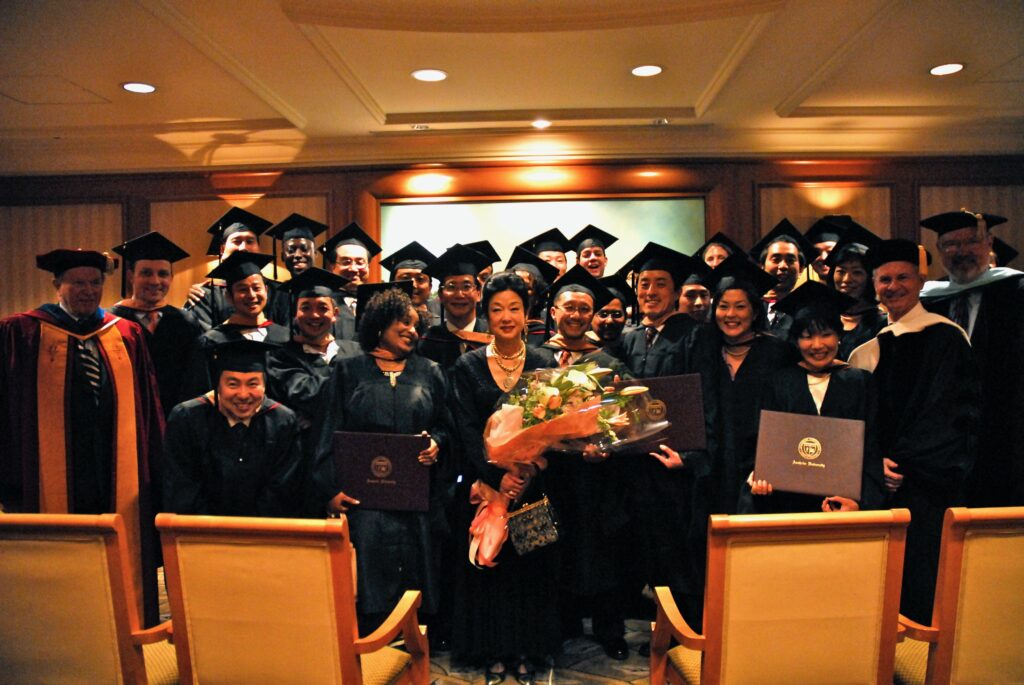
Anaheim University business students study fully online through the Akio Morita School of Business and Kisho Kurokawa Green Institute.
Each course is six weeks long and carries three units, and a new term begins every six weeks. Students select any three of the four sustainability courses below, for a total of 9 units. The maximum time allotted to complete the Graduate Certificate is one year.
Available Courses
Students select any three of the four sustainability courses below. Open any course to read its full description.
Sustainability Courses
The four sustainability courses from the Kisho Kurokawa Green Institute. Students select any three to complete the certificate; course offerings are subject to faculty availability and may vary by term.
The Triple Bottom Line Accounting and Management course is an expanded version of accounting for corporate activity. Contemporary society has moved away from the mere financial bottom line to a higher level of social responsibility where we account for the true social impact of our business activity. Through this expanded version of accounting and accountability, social and environmental impact is added to the equations. Thereby the report of corporate activity and management comprehensively reflects a true bottom line. The three prongs of the true bottom line become clear: economic prosperity, environmental quality and social justice. This course provides the basis for business students to go forward and determine the true social effects of the businesses they are working for and to manage for the future.
Green Marketing & Environmental Product Design/Recycling is a course structured around the traditional “4Ps” of marketing and explains how marketing mix decisions can and do influence environmental outcomes. Throughout the course, the emphasis will be on the conversion of consumption systems to a sustainable paradigm that represents a circular use of resources, not the linear approach (materials > products > consumption > disposal) that leads to the pollution of ecosystems. The major theme of the course is that marketers can reinvent strategy and craft “win-win-win” solutions, where customers win (obtaining genuine benefits), organizations win (achieving financial objectives), and ecosystems win (ecosystem functioning is preserved or enhanced).
Corporate Social Responsibility and Ethics is a comprehensive study of the core issues for business in the questions of sustainability, social responsibility and ethics. The course introduces the student not only to relevant issues, but the views of corporate stakeholders. Approaches for presenting and carrying out a program of sustainability are presented, including strategic planning, targets, goals and alternative approaches. A principal part of the course is devoted to the ethics of business and issues of transparency, including discussion of the social impact of non-ethical and non-transparent business practices. Case studies, a team project and practice assignments assist in presenting these themes on a practical level. The course concludes with information and discussion on trends in sustainability and business ethics. A principal goal of the course is to show that community engagement and the maximization of profit/shareholder value are not mutually exclusive, but mutually reinforcing.
Sustainable Enterprise Development and Leadership is a course which provides a comprehensive and practical analysis of what sustainable business development is and how companies can use it to make a significant difference. Sustainable development involves articulating, integrating and achieving social, economic, and environmental objectives, and initiatives to protect humankind and the natural world from destructive behaviors. Sustainable business development is a holistic management approach which includes the entire value-added system from the origins of raw materials, to production processes, to customer use, to product end of useful life. Sustainable outcomes are those that balance the performance objectives of the present with the needs and expectations of the future. To achieve these outcomes, there must be a profound change in strategic thinking, leadership and the management of businesses.
Program Requirements
Key requirements students complete as they progress through the program and to graduation.
Students select any 3 of the 4 available sustainability courses, for a total of 9 units (3 courses, 3 units each). Course offerings are subject to faculty availability and may vary by term.
Students must maintain a 3.0 grade point average (GPA) in order to graduate. Any student whose GPA falls below 3.0 is placed on Academic Probation and given two terms to bring it back to a 3.0 level. A grade lower than 80% on any course means the course must be repeated.
The maximum time allotted for completion of the Graduate Certificate in Sustainable Management is one year. Extensions require written approval from the Program Director, the Office of the Registrar, and the Office of Financial Affairs.
