
Curriculum
June 2, 2023 2026-09-20 18:43Curriculum
Graduate Diploma in TESOL Curriculum
The Online Graduate Diploma in TESOL is built from six courses chosen from the nine graduate TESOL courses taught on the Master of Arts in TESOL — 24 units in all. Each course is nine weeks long and carries four units, and a new course begins every ten weeks.
There is no thesis, no research portfolio and no residential requirement: the Diploma is completed entirely online, with a ninety-minute live class every week, in around 60 weeks. Students choose the six courses that fit their teaching, from the foundations of second language teaching and learning, through grammar, discourse and acquisition, to classroom research, evaluation and curriculum development.
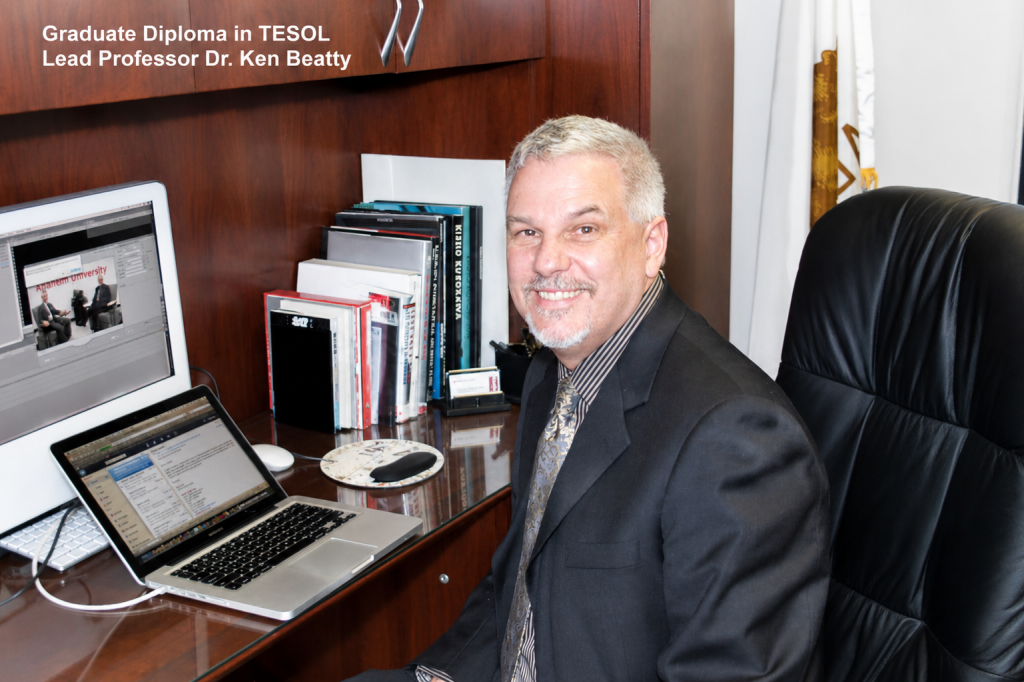
Graduate Diploma in TESOL Lead Professor Dr Ken Beatty
Every course is nine weeks long and carries four units; a new course begins every ten weeks. The Diploma is completed entirely online and takes around 60 weeks; no residential attendance is required.
Choose Six Courses
Any six of the nine courses below make up the Diploma, and the choice is the student’s. Open any course to read its full catalog description.
Course Options
The nine graduate TESOL courses the Diploma draws on, each nine weeks long and worth four units. Six of them, in any combination, complete the program.
Over the last twenty-five years, there have been major changes to the theory and practice of second language teaching and learning. These changes have been driven by changes in educational theory, changes in the way we think about language and learning, and the development of an active research agenda which has provided important insights and ideas for classroom practitioners.
The purpose of this introductory course is to provide an overview of the field of second language teaching and learning, to identify major trends and issues, and to show where they have come from, to illustrate, in practical ways, how these emerging ideas can be incorporated into the students’ own teaching practice, and to provide students with the basic skills and knowledge that will enable them to benefit fully from the rest of the course.
This course introduces students to key grammatical terms and concepts, as well as to techniques and procedures for describing and analyzing texts from a grammatical perspective. It also introduces practical techniques for teaching grammar.
The focus of the course will be on techniques for teaching grammar from a functional perspective. This approach shows language learners how to use the grammar that they are learning to communicate effectively. Students will be involved in collecting samples of spoken and written discourse, and using these to develop classroom exercises.
This course is intended as an accessible introduction to the key concepts of discourse and discourse analysis. It also introduces techniques for teaching discourse in the classroom. Topics covered include the nature of spoken and written discourse, cohesion and coherence, speech act theory, rhetorical analysis, discourse and syntax, discourse in the classroom.
This is an introductory course in second language acquisition. Topics covered in the course include the scope of SLA research, the history and development of SLA research, interlanguage development, the linguistic environment for SLA, learner variables, instructed second language acquisition, and applications of SLA to pedagogy.
This course focuses on central issues and concerns relating to the effective management of teaching and learning processes in second and foreign language classrooms. In this course management does not mean the creation of budgets and the creation of time lines, but the creation of a positive pedagogical environment which facilitates learning.
The focus of the course is on the professional decisions that teachers must make in order to ensure that learning takes place effectively. Content will include lesson planning; teacher talk, including the effective use of questions, the provision of explanations and the use of feedback; classroom dynamics; instructional groups, small group work, dealing with large classes, one-to-one teaching, and learner-teacher roles; affective issues in the language classroom; and classroom monitoring and evaluation.
This course is intended as an accessible introduction to the field of second language classroom research. It covers both methodological and substantive issues. At the end of the course, you should have a good idea of the questions and issues that have been investigated in language classroom, and how they have been investigated. You should also have developed practical skills for investigating your own classrooms.
The aim of this course is to introduce students to classroom-based evaluation. This is a critically important area for all those involved in curriculum development, program management, and, in fact, any area of educational leadership. The overall goal of the courses is to give students the skills in the design and evaluation of a program of the student’s choice.
The purpose of this course is to provide teachers with tools and techniques for analyzing, modifying and developing courses for language teaching.
Students will look at issues to do with selecting and grading content, selecting, sequencing and integrating learning tasks and activities, and selecting assessment tools and techniques.
The aim of this course is to introduce students to research issues and methods in language acquisition and use, and to familiarize them with recent research in the field. The overall goal of the course is a practical one, that is, to equip students to design, implement and evaluate their own research project.
Program Requirements
What the Diploma asks of students alongside the six courses, as published in the program catalog.
Students must maintain a 3.0 grade point average (GPA) in order to graduate from the program.
Students meet in real-time interactive online classes with their professor and fellow students for ninety minutes every week during each of the courses.
The Graduate Diploma is completed entirely online. Unlike the MA and the Ed.D. in TESOL, it carries no residential seminar requirement, and there is no thesis, research portfolio or comprehensive examination.
The Diploma takes approximately 60 weeks. Maximum time allotted to complete program – 2.5 years from date of matriculation.
